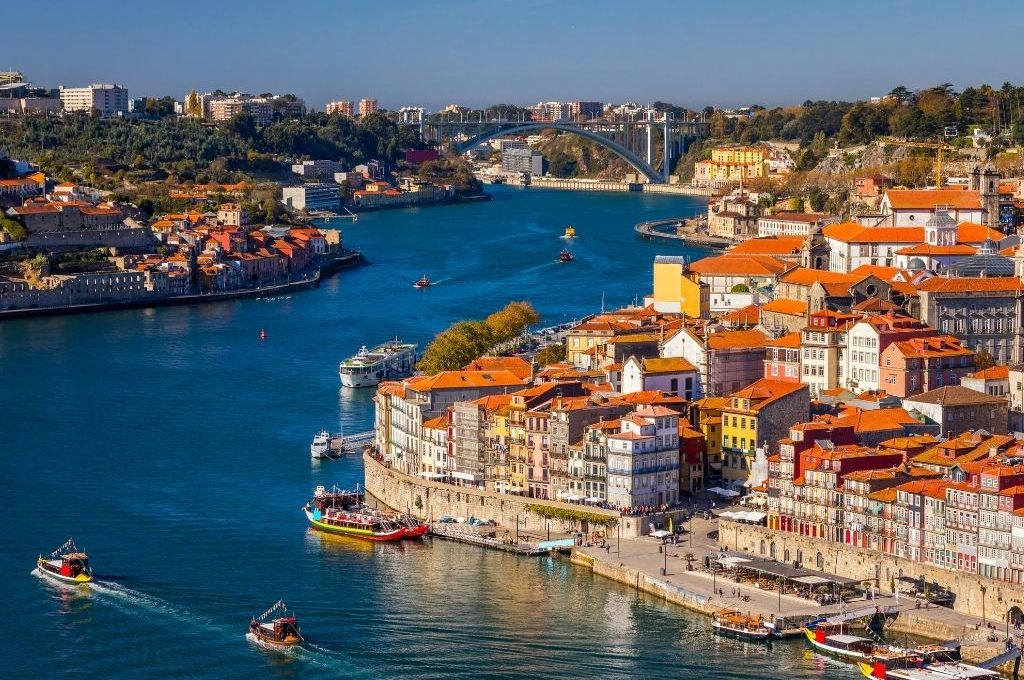
Porto is a city that looks like it’s straight out of a postcard at first glance. With its colorful houses leaning against the river, it stretches from the hillsides down to the sea. The sounds of trams echoing through its narrow streets and the bridges spanning the Douro River are details that make Porto enchanting. There is a spirit here where old and new intertwine at every corner. As you wander among the historic buildings, you might stumble upon a wine cellar in one corner and a modern café in another. Porto is not a place for rushing; it exists more for savoring than for sightseeing.
️ Reminder: To explore Porto step by step with your digital tour guide, don’t forget to download Piri Guide!
Where is Porto?
Porto is a port city located on the banks of the Douro River in northern Portugal. It is situated approximately 300 kilometers north of Lisbon. Although it is the country’s second largest city, its atmosphere is much more tranquil than the capital. Where the river meets the ocean, it looks like a picture postcard with its colorful houses built on the slopes.
The Best Season to Visit Porto?
Porto is beautiful in every season, but spring and fall are the most enjoyable. Between April and June, the weather is perfect for sightseeing, the city streets come alive, but the crowds haven’t arrived yet. September and October are also uniquely beautiful; the vineyards change color, and the city calms down. Summer can be a bit crowded and hot, while winter brings plenty of rain, but Porto’s melancholic atmosphere truly comes to life during those days.
How to Get to Porto?
The easiest way to get to Porto is by plane, of course. The city’s airport, Francisco Sá Carneiro, is only 20 minutes from the city center. You can take the metro from the airport and get straight to the center, which is both cheap and practical.
If you’re coming from Lisbon, you can also get there by train or bus. The Alfa Pendular high-speed trains will get you to Porto in about 3 hours. If you’re looking for scenic views, the train line that runs along the Douro River is also a great option. Driving there is also nice, but let’s be clear from the start: parking in Porto takes a bit of patience.
If your plans include Lisbon, make sure to check out our Lisbon travel guide!
Must-Visit Places in Porto
We’ve made a list of must-visit places in Porto. Yet, we should remind you that you can find more on Piri Guide mobile app. Piri Guide detects your location, offers you the best travel routes, and starts telling you the hidden stories of wherever you are. All you have to do is to get your headphones or earbuds and follow the path at your own pace. Then, don’t set out for your trip before downloading the digital travel guide!
Chapel of Santa Catarina
The Santa Catarina Chapel is located in the heart of the city, on Rua de Santa Catarina, Porto’s most famous shopping street. When it was built in the 18th century, it was more modest in appearance and made of wood. It was renovated and expanded in 1801. The chapel is also called the “Chapel of Souls” because since the 18th century, a statue of Our Lady of Souls has stood beneath it. Our Lady of Souls is the Virgin Mary, who is considered the protector of souls in Purgatory.
The Santa Catarina Chapel is one of the most photographed places in Porto. Its facade, covered in blue and white tiles, attracts a lot of attention. These tiles, known as azulejos, were designed in 1929 by the artist Eduardo Leite. There are more than 15,000 tiles here. They depict scenes from the Bible, such as the death of St. Francis of Assisi and the martyrdom of St. Catherine.
Hidden Gem: Livraria Lello
Livraria Lello was among Portugal’s leading book importers and exporters until 1950. In 2006, Spanish author Enrique Vila-Matas published an article in El País newspaper. It was then that it was first referred to as “The Most Beautiful Bookstore in the World.” It is a bookstore, yes, but not the kind you just wander into and leave. When you enter, you will first encounter a magnificent red staircase. The staircase is one of Porto’s most photographed spots.
The building was designed by engineer Francisco Xavier Esteves. It is a beautiful example of neo-Gothic architecture. You can recognize the Gothic style by its vertical forms reaching towards the sky and its thin, pointed extensions. Look, there are two figures on the facade representing science and art. These figures were painted by artist José Bielman. Another reason this bookstore is so famous is the Harry Potter series. Rumor has it that J.K. Rowling got the idea for Harry Potter in Porto, specifically in this library.
Stock Exchange Palace (Palácio da Bolsa)
The Stock Exchange Palace is one of Porto’s most magnificent buildings. Built in the 19th century as a meeting place for Porto’s merchants, its neoclassical style, with its simple yet powerful lines, reflects the power of the merchants and the wealth of the city. The exterior is noble, but the real splendor is inside!
Upon entering, you are first greeted by the Courtyard of Nations, surrounded by marble columns. Daylight floods in through the glass ceiling. As you ascend the marble and granite stairs, the Golden Room, the General Assembly Hall, and other ornate rooms await you. Gold leaf on the ceilings, intricate craftsmanship on the walls, crystal chandeliers in the halls… The palace’s interior decoration began in the 1860s but was completed in 1909, prior to King Manuel II’s visit.
Ribeira & Guindais Funicular
The funicular opened in 1891. It connects the Batalha district above to Ribeira. In two minutes, you find yourself in the upper part of the city without getting tired. Did you know that two years after it opened, the funicular closed due to an accident? A brake failure caused the funicular to lose control. People were injured, and some even lost their lives. That’s why the people of Porto were afraid of the funicular. The funicular was the only one of its kind for a century, until 2004.
Ribeira is the historic part of Porto. This area is known for its pastel-colored houses, taverns, and boats. Today, the area is on the UNESCO World Heritage List. It is not known when the Ribeira area was first settled. It is known that Porto developed in the Pena Ventosa district, on the hill where the cathedral stands. Later, a settlement began to form along the riverbank. Archaeological studies show that there was a port here during the Roman period. The port may have been the main reason for settlement here.